Students from the University of Nova Gorica visited Prague with the CEEPUS mobility grants
Students taking the elective subject Cultural Tourism 2023/24 travelled to Prague for Easter at the end of March 2024. They acted as tour guides in a seminar organised by MSc. Nikita Peresin Meden, they prepared the tourist programme and the content of the historical and cultural sights. They also tested the programme in Prague and learned about the advantages and disadvantages of cultural tourism.
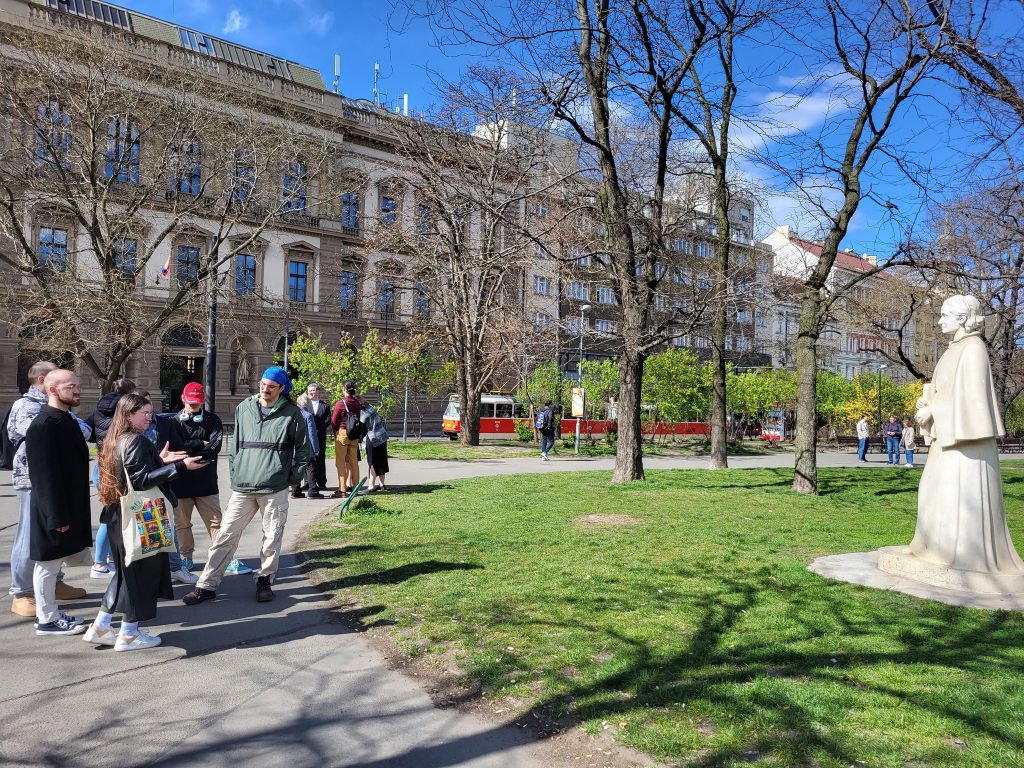
Here is how two students summarized their impressions.
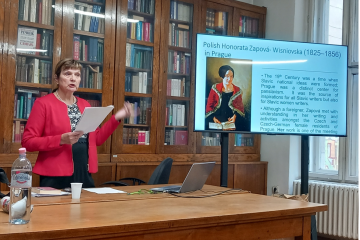
“The study trip and the exchange were divided into three parts: Firstly, students from the University of Nova Gorica, School of Humanities, and Charles University, Faculty of Arts, met for a captivating lecture on spring rituals and Easter customs. Dr Jasna Fakin Bajec led the discussion and gave insights into Slovenian traditions, while Dr Alenka Jensterle Doležal explained fascinating facets of Czech rituals. Later, the Slovenian students deepened their knowledge of cultural heritage and ethnographic research methods in another lecture by Dr Bajec. Next, we went on a study trip to Prague and immersed ourselves in the world of tourist guides. We learnt about the intricacies of cultural tourism and experienced both the challenges and the rewards. As we wandered through Prague’s architectural marvels, significant historical landmarks and Czech cuisine, we unravelled the rich fabric of the city. From Charles Bridge to Prague Castle, from Lenin’s Wall to Wenceslas Square, every corner revealed a story. We explored the history of Charles University, the charm of the Old Town and the splendour of Vyšehrad and experienced the essence of Prague first hand.the third part was a poignant exploration of Slovenian and Czech women writers. We paid homage to literary luminaries such as Zofka Kveder, Božena Nemcova, Karolina Svetla and Eliška Krasnohorska. I had the privilege of presenting Karolina Svetla’s legacy to my group and providing insights into her life and work during a visit to her resting place. In Vyšehrad, we paid our respects to the important figures of Czech literature at the cemetery. We also attended the opening of the exhibition “Slovenian Modernism in the Czech Environment” and witnessed the unveiling of a memorial plaque dedicated to Zofka Kveder. To summarise, on our trip we were able to take on the role of tourist guides and gain deep insights into Prague. Through these experiences, we built a deeper connection with the city and its cultural heritage and enriched our understanding and appreciation of the city’s intricacies.
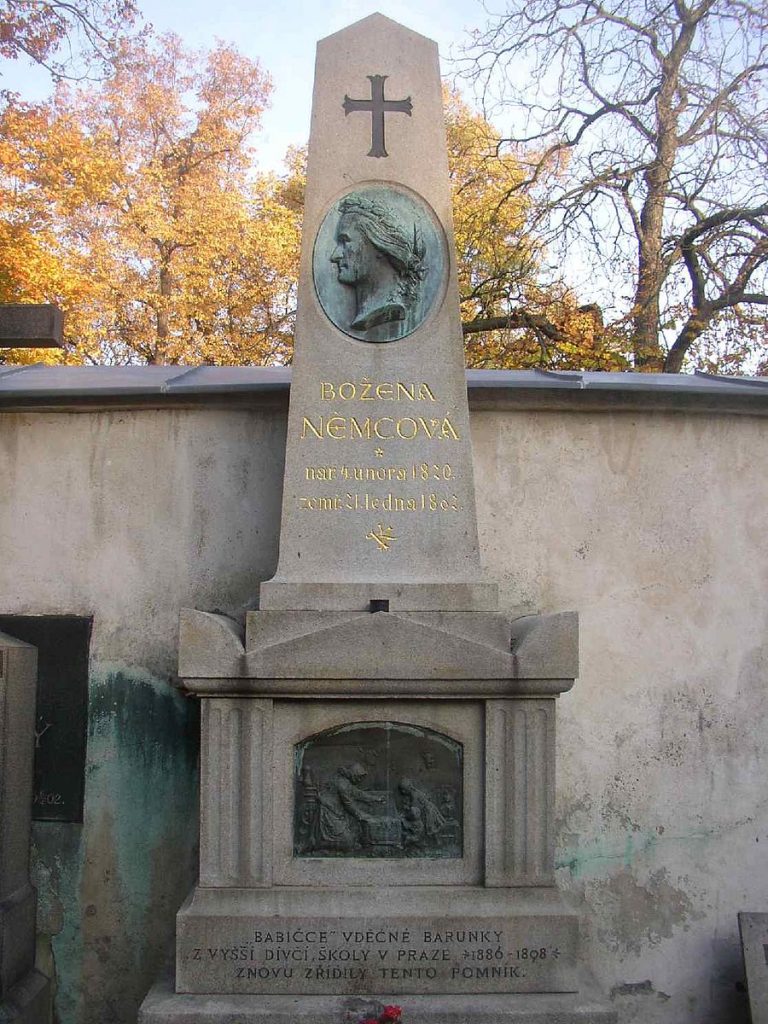
The writer I have chosen to talk about, Božena Němcová, is associated with a certain feeling. The first thing that prompted me to talk about her was her name. She has the same name as my grandmother, and what’s more, her best-known work is also based on her grandmother.
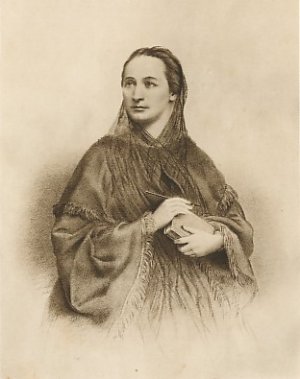
(Image source: Wikipedia)
She was born in the 19th century and had a very complicated life, from a failed marriage to an early death; her life was not, as they say, sunshine and rainbows.
Even sadder about her life is the fact, or rather speculation, about her mysterious upbringing and the enigma that follows her life of misguided and lost origins. The enigma that haunts her is the mystery of her date of birth and whether she is an illegitimate child of Wilhelmine’s sister, but all of that is just speculation.
As I mentioned earlier, her most famous work was called The Grandmother, inspired by true events when she lived in the country with her parents and maternal grandmother. If you ask me, this was a very important work. It was written by a woman and shaped the history of women writers not only in today’s Czech Republic, but in the whole world.
Her mark on history, like her books, is of great importance. She was one of the people, women, who set the whole movement in motion, and she carried it through with great courage and bravery.
Just how important she was for Czech history can be seen at the cemetery in Vyshehrad in Prague, where she is buried in a cemetery that is important for Czech history.”
I got to know the Czech author Milada Součková quite by chance. Under the influence of the Women Writers in History conference, I read an article about Czech women writers who deserve to be translated into English, and it was there that I first became acquainted with Milada Součková’s work. What particularly caught my attention was her life and work in exile. In short, Milada Součková was a Czech writer, literary historian and theorist, journalist, diplomat and, above all, dissident. She was born into a wealthy Prague family at the end of the 19th century and was educated at Charles University and the University of Lausanne. She lived and worked in Prague. Her work is characterised by linguistic experiments and avant-garde literature, strongly influenced by James Joyce and Virginia Woolf. She introduced modernist techniques and a stream of consciousness into Czech literature.
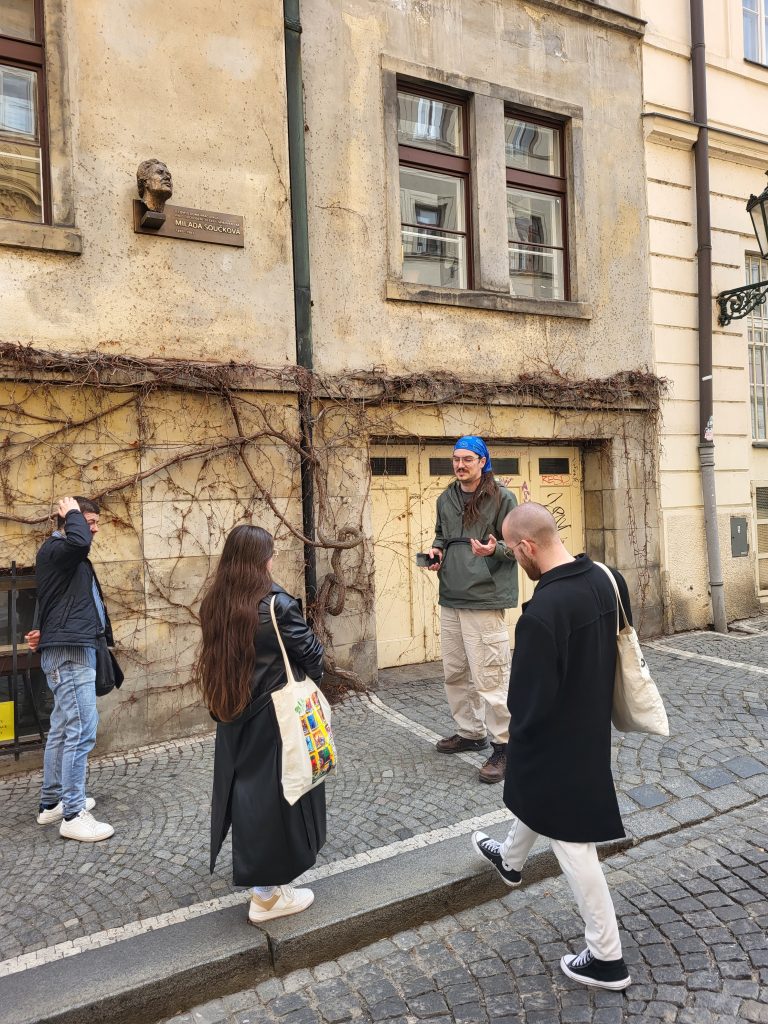
During the Second World War, she was an opponent of the Nazi occupation and co-operated with the Prague Linguistic Circle. After the end of the war, she was a cultural attaché in the USA (until the Soviet occupation of Czechoslovakia). She continued her life in the USA and worked at the universities of Harvard, Chicago and Berkeley. However, she remained attached to Czech culture and language. She wrote her literary works in Czech, but her professional articles were written in English. In retirement, she worked as a librarian in a library. Unfortunately, she was not recognised as an enemy of the Soviet communist regime in the Czech Republic until after her death in 1989. I am glad that she was not forgotten in the end and that there is a memorial plaque to her in Prague.
Authors: Neja Vodopivec, Momir Trifunjagić, Gordan Stefanov