The guest lectures by Prof. Dr. Alenka Jensterle Doležal
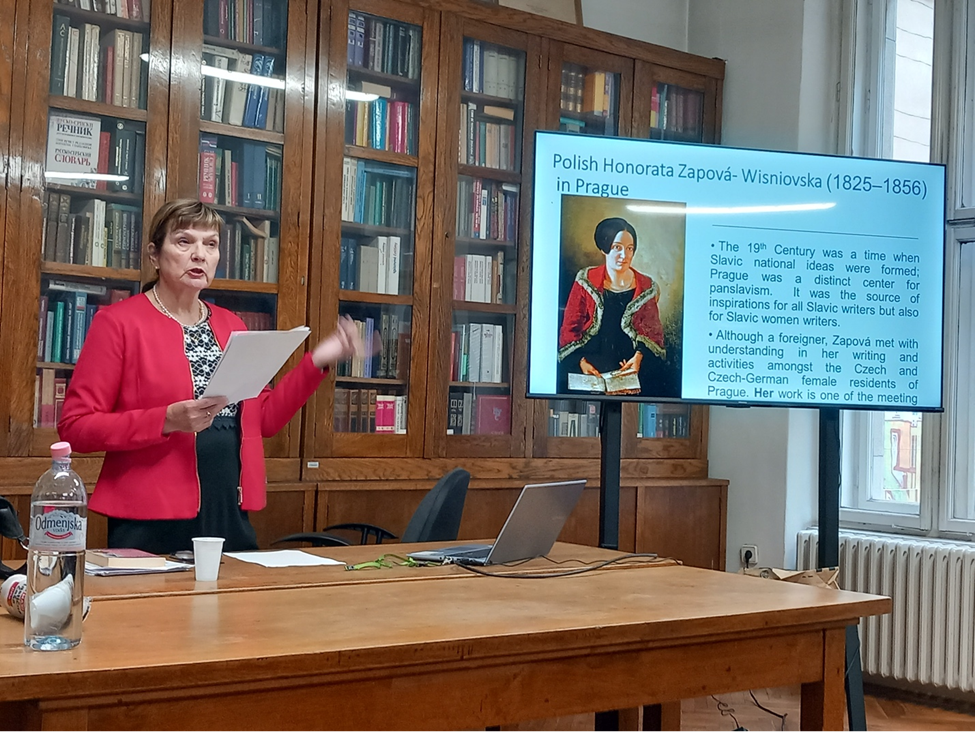
Alenka Jensterle Doležal, a professor from the Charles University in Prague, held lectures about Slovenian women writers and Julka Chlapec-Đorđević (Julka Hlapec Đorđević) (1882 – 1969) at the Faculty of Philology in Belgrade in April this year.
Prof. Jensterle Doležal visited Belgrade within the CEEPUS network Women Writers in History and on that occasion held lectures at the doctoral course Theories of Gender and Difference and Digital Humanities which were attended by students of Czech language and literature as well as students of Slovenian language and literature.
Within the lecture of Julka Chlapec-Đorđević, a Serbian intellectual and feminist, who spent her most fruitful years in Prague (1922 – 1945), professor Jensterle Doležal spoke about her epistolary novel One Correspondence: Fragments of Novel (1932) and the problems she thematized in it.
When it comes to Slovenian women writers, professor Jensterle Doležal talked about the most significant characteristics of Slovene modernism as well as its most important writers: Ivan Cankar (1876 – 1918), Oton Župančič (1878 – 1949), Dragotin Kette (1876 – 1899) and Josip Murn – Aleksandrov (1879 – 1901), who made a significant turn in the culture of artistic creation and brought a new perspective. Also, two important cultural centers of the Habsburg monarchy were mentioned which are Vienna and Prague on the fin de siècle, and the journal Slovenka dedicated to women writers publishing in Trieste since 1897. and thereby introduced into the central part of her lecture to which she will devote most of the time and that part is dedicated to Zofka Kveder (1878 – 1926).
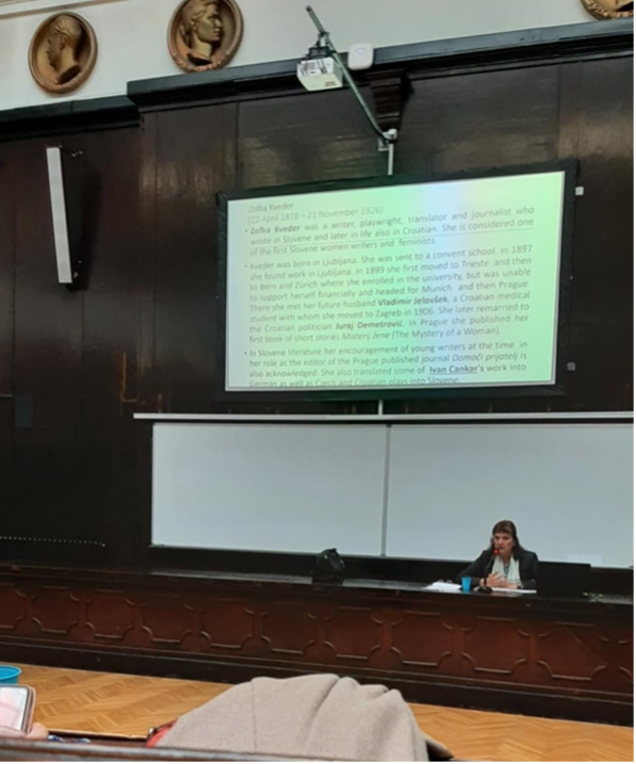
It was discussed in more detail about the life and work of Slovenian modernist woman writer Zofka Kveder, who is considered one of the first Slovene women writers and feminists, with a special review of her creative work in Prague, Zagreb and Ljubljana and her works in Czech, Croatian and Slovenian languages. Zofka’s work abounds with a feminine sensibility, searching for identity as well as finding her voice in a patriarchal society.
Special emphasis was placed on the fruitful relationship with Zdenka Hásková (1878–1946) who was Zofka’s close friend as well as a proofreader and translator of Zofka’s work into the Czech language during her stay in Prague from 1900. to 1906. Also, it was highlighted the importance of the literary salon led by Růžena Svobodová (1868 – 1920), an important Czech female author of that time, and the importance of the author herself since she was a great influence on Zofka Kveder’s work, which the professor spoke about in more detail. The comparison was pulled between two novels, one written by Zofka, Her Life (Njeno življenje)1914. and the other one by Ružena Svobodova, Women Lovers (Milenky) 1902. emphasizing the same motifs and narrative techniques, regarding the main topic of modernism which is a new, modern, „liberated“ woman who does not submit to any man in the patriarchal society. Zofka’s first collection of stories The Mystery of a Woman (Misterij Žene) was published in Prague, in1900. Aside from stories, she also wrote one play Love (Ljubezen) in 1901.
In addition to Zofka Kveder, there was a talk about Helena Maliřová (1877–1940) who was a close friend of Zofka Kveder and Zdenka Haskova and was also an important female writer in modern Prague. Her creative work is also greatly influenced by the literary salon of Ružena Svobodova whom she considered the greatest mentor and role model.
Even though the motifs of “Golden Prague” were dominant in Zofka’s work, it was stressed that her most successful period of creativity was during her stay in Zagreb where she moved with her family in 1906. In Zagreb, she published her most successful novels – Her Life (Njeno življenje) in 1914. written in Slovenian language, and Hanka (Hanka) in 1918. written in Croatian language. Those novels represent a turning point in the authors’ search for identity and literary expression.
The other important Slovenian female authors were mentioned, such as Vida Jeraj (1860 – 1932), Ljudmila Poljanec (1874 – 1948) and Lili Novy (1885 – 1958), and the final part of the lecture was dedicated to questions and discussion.
Jovana Rašković
This text is published in the journal Knjiženstvo.