Summer School 2024 report, written by the participant Marija Bosančić, MA
An interdisciplinary international summer school titled SEXUAL DESIRE UNBOUND: LITERATURE, LANDSCAPES, AND DIGITAL DIALOGUES took place in Ljubljana, from 27th August to 02nd September 2024. It was organized within the CEEPUS Network Women Writers in History, by the University of Nova Gorica, and it was supported by the organization Women Writers Route and others.
Twenty-three students, from seven different countries (North Macedonia, Slovakia, Poland, Slovenia, Serbia, Croatia and the Czech Republic) participated. Lecturers came not only from the aforementioned countries, but also from Ireland, Bulgaria and Romania.
We are sharing, herein, a detailed report on the lectures, events and impressions from one of the participants from Serbia, Marija Bosančić, a PhD student at the Faculty of Philology, University of Belgrade.
Impressions from Slovenia
We spent the last week of August 2024 as a part of a marvelous and unique summer school in Ljubljana, Slovenia, which was organized by the University of Nova Gorica. This was, actually, a second installment of the international summer school organized by them, and I had the honor to participate in it for the second time. We discussed the exploration of sexual desire in literature, more precisely in women’s writing and art, while also examining the broader cultural implications that follow it.
Namely, the complete subject was: Sexual Desire Unbound: Literature, Landscapes and Digital Dialogues, and we were supposed to examine it from two points of view – from the standpoint of digital humanities and literary tourism. Before the summer school began, we had to choose a track, which ultimately determined from which perspective we would consider the question of sexual desire in literature. During those seven days, we had a chance to talk about this in both a formal and an informal setting, by placing it in different contexts and approaching it from different perspectives.
This summer school was designed as a sequence of mutual and separate, specialized, workshops and lectures, excursions and particular events. All these workshops and lectures were led by experienced researchers and lecturers (members of the CEEPUS network) who have given us, the participants, a chance to expand our knowledge not only within the domain of gender studies, but also literature, digital humanities and literary tourism.
Most of the lectures and workshops were held in the Faculty of Arts, University of Ljubljana. Among these were the initial lectures as well. Same as the last time, the organizers and coordinators of the program have welcomed us wholeheartedly. We, the participants, then, had a chance to get acquainted among ourselves in a truly unique introductory session titled Introductory Session: Summer School on Sexual Desire? which was led by Darko Ilin, a PhD student at the University of Nova Gorica, the main coordinator of the program and our greatest support throughout this period. In a very creative manner, he managed to introduce us to the main subject of the summer school, familiarize us with the school program and make us feel so relaxed that, after that first session, we had a better picture of who we are surrounded with, and what are our colleagues’ not only professional but also personal interests. It was thanks to this that we were able to work in a pleasant and inspirational environment throughout the entire duration of the summer school.
After this first session, we had a chance to listen to three amazing introductory lectures and to discuss them further. The first introductory lecture was held by Prof. Katja Mihurko on the topic of Locating and Digitally Archiving Desire: Insights and Research Reflections. Prof. Mihurko discussed the problem of how sexual desire is portrayed in literature, i.e. the lack thereof in women’s literature and how to find more examples of it. By giving us a concise historical overview, Prof. Mihurko shed light on some of the ways women left traces of sexual desire in literature and suggested some research methods in which the academia can discover new and relevant examples for future research.
Prof. Marie-Louise Coolahan, from the National University of Ireland, Galway, held the second introductory lecture – Digital Humanities Innovations for the History of Women’s Writing. This lecture focused on the practical aspects of digital humanities. In fact, Prof. Coolahan shared with us how she started and led her project (RECIRC: The Reception and Circulation of Early Modern Women’s Writing, 1550-1700), what the process looked like, which criteria she took into account, what kind of obstacles she encountered with and how she overcame them; all of which is very significant for young researchers like us because we do not get many chances to catch a glimpse behind the scenes when it comes to the creation and management of such projects.
Prof. Jasna Potočnik Topler from the University of Maribor, Faculty of Tourism, held the introductory lecture about literary tourism titled Introduction to Literary Tourism. Within this lecture, we heard a little bit more about the intersectionality between literature and tourism, and we were able to see in what ways literature and its content can inspire and develop local tourism. Prof. Potočnik Topler taught us about the main concepts and the role of literary places in cultural tourism. More importantly, she talked about how we can use both when promoting certain places (countries, cities, regions) and how literature influences our understanding of those places. Moreover, she underlined in what ways it contributes to the preservation of cultural heritage.
The first day ended in a wonderful location, in Villa Zlatica.[1] First, we had a chance to get acquainted with the history of the villa and its owners through a charming little tour. With the intriguing account, we got a chance to walk through all the rooms and we were able to get a sense of the time as it is highly preserved and authentic, as a sort of a time capsule. Afterwards, Darko Ilin presented the project in which he participated through a witty talk titled Match My Epistolary Freak: Sexual Desire in the Electronic Collection PISMA/LETTERS. Moreover, through various examples, he shared some of the insights he had come to in regards to the portrayal, or better yet, coding of sexual desire within the epistolary material they processed.
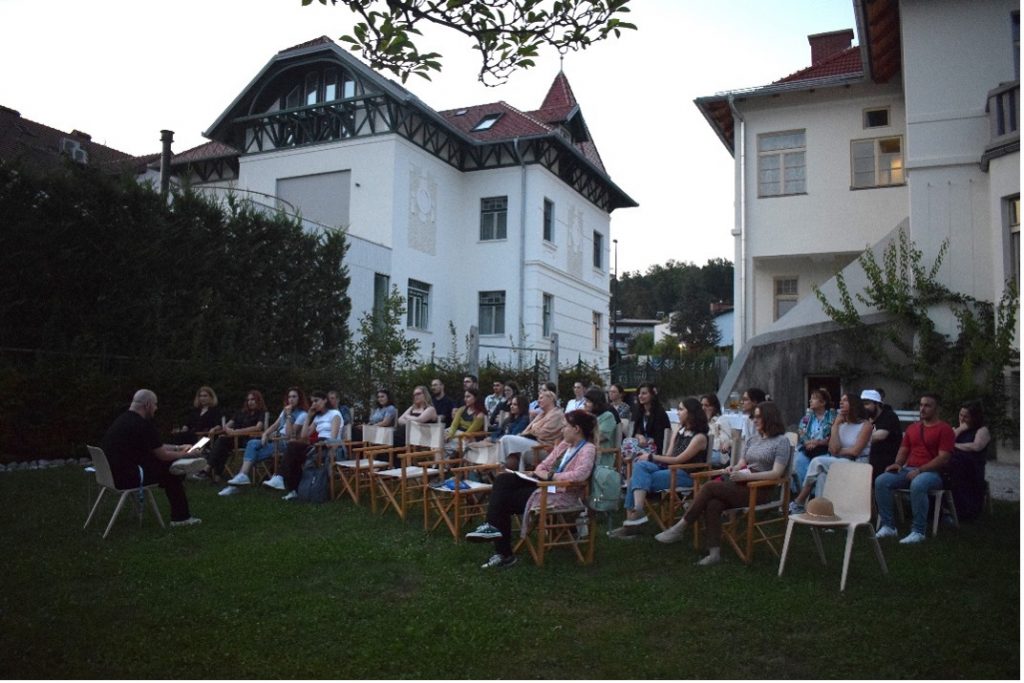
Darko Ilin’s lecture Match My Epistolary Freak: Sexual Desire in the Electronic Collection PISMA/LETTERS at Villa Zlatica
The following morning, we went to Vipava and Nova Gorica where we heard two lectures and were a part of the specialized workshops. The first lecture of the day was held by Prof. Carmen Beatrice Duțu and Prof. Roxana Patraș on the topic of The PBL Method and Educational Technologies in Humanities. A Graduate Research Practical Guide. Within this lecture, Prof Duțu and Patraș portrayed some methods we can always use when defining our projects, especially when it comes to digital humanities.
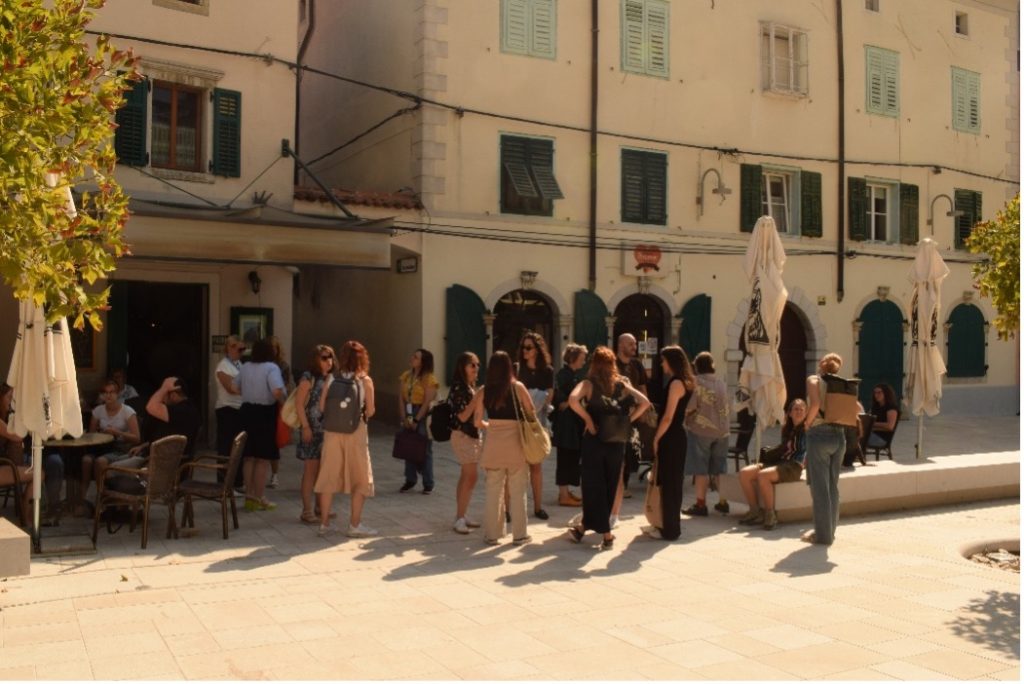
Vipava, free time and visiting the main building of the University of Nova Gorica
Prof. Primož Mlačnik gave the following lecture titled Politics of Sexuality in Slovenian Crime Fiction from “moderna” and Ljuba Prenner to the 21st Century. Prof. Mlačnik shed some light on the connection between sexual desire and crime fiction through a brief theoretical introduction which focused on examining, through certain works of art, the liaison between the poetics of the genre(s) and the Western politics of sexuality.
Specialized workshops ensued right after. The first one, titled Women’s Writing, Digital Humanities and Literary Tourism, was led by Prof. Biljana Dojčinović from the University of Belgrade, Faculty of Philology. Within this interactive workshop, we got a chance to hear more about the projects Prof. Dojčinović led over the years (Knjiženstvo and Knjiženstveni Belgrade). These particular cases were quite inspirational and served as great examples when it was our time to plan our projects which were, at that point, ahead of us. What should, also, be said is that this workshop was truly special. Instead of taking the traditional approach and analyzing the text in front of us, we were asked to dramatize the text while extracting that subtle hint of sexual desire. This task was, if I might add humbly, completed quite successfully. The task itself has shown us that texts are always nuanced and that for sexual desire to be present in a text, it does not have to be portrayed in a vulgar manner or so conspicuously.
Afterwards, we spent the evening walking around Gorizia. Our aim was to discover, on our own, some locations which were important for writers and artists from that city, such as Carolina Luzzato Coen, Maria von Egger, Marica Nadlišek Bartol, Mara von Berks and Ljubka Šorli, etc. This enabled us to feel the spirit of the place in our own way, i.e. at our own pace, as well as to expand our knowledge. I believe that, until that moment, some of these names were unknown, at least to the majority of the group. In this way, we got a chance to, in an unconventional way, learn something new which can, certainly, help us in our future research.
The following day began with Prof. Alenka Jensterle Doležal’s lecture Dialogue Between the Writer and the City. Prof. Doležal told us about the work of Zofka Kveder and she shared some of her insights regarding Kveder’s relationship with her surroundings, i.e. the city. We were, then, given a chance to present our mini-projects, which we prepared in advance, where we wrote about a writer of our choice and her connection with a city. This was, actually, a unique opportunity for us to hear about various writers, maybe even some of which we never would have discovered in our research, which, definitely, expanded our horizons.
Prof. Maša Grdešić held the following workshop – Sexual Desire, Political Power. In this workshop, we discussed the connection between these two concepts on the example of Marija Jurić Zagorka’s novel, along with a contemporary one written by Chris Kraus. Through these examples, Prof. Grdešić showed us that sexual desire can be understood, metaphorically, as desire or hunger for power which can facilitate or enable freedom of movement, as well as political and artistic freedom in public space.
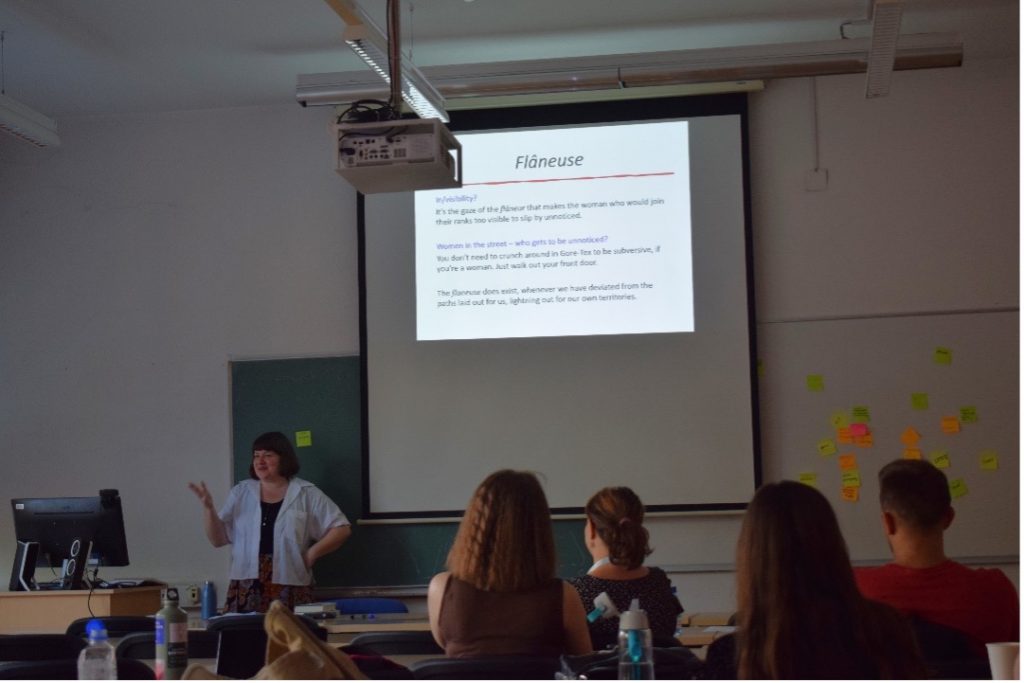
Workshop led by Prof. Maša Grdešić – Sexual Desire, Political Power
The following activity was organized later that evening. Namely, we were a part of a guest lecture, an informal talk, titled Performance and Sexuality: A Conversation with Tjaša Črnigoj, where we had a chance to listen to Tjaša Črnigoj, a theater director whose last project Sex Education II explores sexuality as a fundamental human right through a series of lecture-performances. This conversation, moderated by Tery Žeželj, covered a wide array of subjects: from sexuality as a basic human right to the importance of bringing it into the field of performing arts. Moreover, Tjaša shared with us some details about what the process of working on this project looked like, along with some practical advice on how to use feminist strategies in creative collaboration.
That Friday, our lectures and workshops began a bit later than usual, with the session led by Prof. Nadezhda Alexandrova on the topic of Power Dynamics, Orientalism and Projections of Sexual Desire. Namely, this lecture reminded us, through specific examples, that it is much more frequent to see sexual desire portrayed by men in literature. Furthermore, we could also see how they write about women and how sexual desire is exploited as a means of stigmatization.
The penultimate, formal, workshop ensued where we were grouped and where we got the chance to brainstorm the ideas for our final projects. All this was, of course, supervised by our mentors – Prof. Carmen Beatrice Duțu and Prof. Nadezhda Alexandrova. From our point of view, and here I refer to the group I worked with on our final project, I can certainly say that previous workshops and introductory lectures were of great significance to us when we were supposed to define our subject. With all the input we got during the summer school, we decided to make our own literary tour. However, what we came up with that day was just the beginning.
Later that evening, we went to Club Tiffany, in Metelkova, where we were a part of a literary evening titled Queer Sexuality in Contemporary Slovenian Literature: A Literary Evening with Suzana Tratnik and Pino Pograjc. This was a great opportunity for us to get to know two authors – Suzana Tratnik and Pino Pograjc – who have contributed to the development of queer literature and scene with their life and their work. They shared the ups and downs of their life with us, along with what encouraged them to persevere in their art. To me it seems that this talk meant a lot to everyone – be it whether it has proven that we are not alone in our struggles, that someone else, in fact, understands us or is going through something similar, or that there are still some issues that require a lot of thought and mutual effort from us as a society.
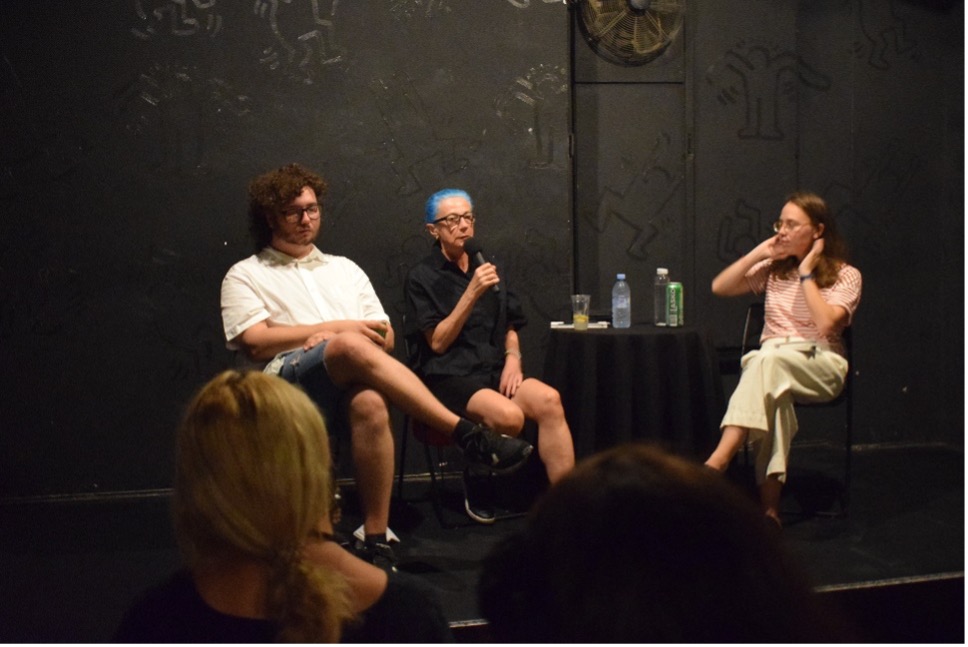
Club Tiffany, Metelkova, literary evening with Suzana Tratnik and Pino Pograjc titled Queer Sexuality in Contemporary Slovenian Literature: A Literary Evening with Suzana Tratnik and Pino Pograjc
We spent the last day of August 2024 on a field trip. We visited Celje, the birth town of Alma Karlin and we visited the Regional Museum of Celje where we went on a tour of an exhibit in her honor. We heard about her life, art and travels. We were acquainted with her character and we learned what motivated her to travel around the world for so long. We saw where she started off and which countries she visited, but also what she sent back home. We found out she was the first woman who went into the world in such a brave manner – independent from her parents or any other family members. With only her work and effort, and most importantly through constant development and learning, she travelled the world on her own when that was impossible for women. Now, several months after everything, it seems to me that this field trip was, perhaps, the most important part of the summer school. By going into nature for a bit and getting away from the mundane life, by spending the day together in an encouraging environment, we were able to evoke the best and the most creative ideas for our final projects. This was, I think, the ultimate plan of our organizers, so I would like to thank them once again for this lovely idea and to commend it. Hopefully, this will bring forward more of these informal types of lectures in any future programs.
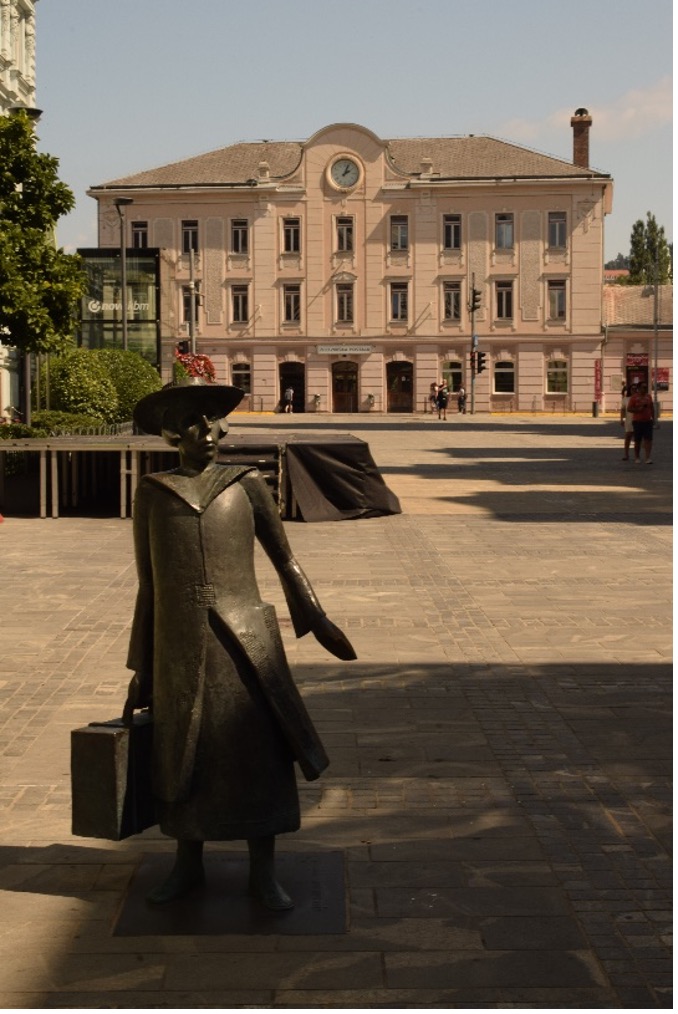
Alma Karlin’s statue in Celje
The following day was, per our schedule, free, however, that did not mean we had free time at all. Namely, we spent the day working on our presentations and flâneuse-ing around Ljubljana at our own pace.
This leads us to the last day of our summer school where all of us got a chance to present our projects, to talk about all the aspects we took into consideration – how we would apply for funding, what would the project encompass, who would be our target group, which social issue would we focus on, etc. This experience was truly valuable for each and every one of us because it gave us a chance to see what the process looks like, what we should pay attention to and why. Moreover, it gave us a chance to evaluate what our strong and weak points were. What I liked the most about this experience was the fact that all groups which presented their projects thought of unique programs which can be applied in the real world; which, I believe, is best described through the words of Benjamin Franklin: “Tell me and I forget. Teach me and I remember. Involve me and I learn.”
Thanks to the innovative and special approach of this summer school, all participants got to internalize and take with them new skills that can be used both in future research and regular work. Contrary to the first summer school, where we were only able to scratch the surface of some important questions within the field of literature and culture, in this one we were introduced to the subject matter in a practical way, as well. Conversations with the mentors, lecturers and guest lecturers all helped create a broader picture, like some mosaic, about sexual desire in literature and in what ways we can use digital humanities and literary tourism to study and examine it.
Without an ounce of guilt, I can attest that I, now, feel at home in Ljubljana and Slovenia, which is all thanks to our wonderful hosts and organizers. This whole program, the workshops and lectures, and all the informal and formal exchange of opinions, made this experience one of the most valuable ones I will forever carry with me.
MA Marija Bosančić
This text is published in the journal Knjiženstvo.
Photography : MA Jovana Rašković